
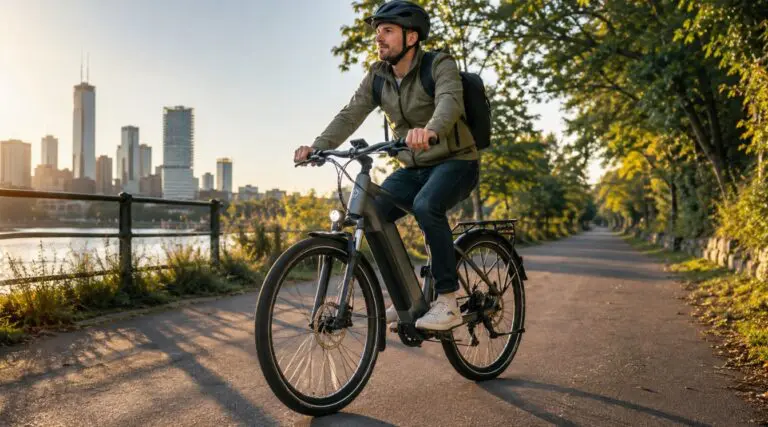
Long-range electric bikes in 2026 are no longer limited to oversized touring machines.
Several commuter-friendly models now advertise 70 to 85 miles of assisted range while adding racks, fenders, lights, suspension and security features that make them useful from Monday morning through a weekend ride.
The strongest choices are the Lectric XP4 750, Segway Myon, Specialized Turbo Vado 5.0 and Aventon Level 3.
Their published ranges are manufacturer estimates, not guarantees, so the best e-bike is the one that still covers your route after allowing for hills, weather, cargo and higher assist settings.
The best long range electric bikes to shortlist in 2026

For most riders, these four models cover the main long-range use cases. The Lectric XP4 750 offers the highest claimed range here and folds for storage, while the Segway Myon combines an 80-mile claim with electronic shifting and connected security features.
Specialized focuses more heavily on ride quality, and Aventon keeps the package commuter-oriented. All four also support speeds up to 28 mph in configurations or modes where local rules permit it, making legal classification part of the buying decision.
| Model | Claimed range | Best fit |
| Lectric XP4 750 | Up to 85 miles | Value and folding utility |
| Segway Myon | Up to 80 miles | Tech-focused commuting |
| Specialized Turbo Vado 5.0 | Up to 75 miles | Premium everyday riding |
| Aventon Level 3 | Up to 70 miles | Balanced city commuting |
Battery capacity matters more than the headline mileage
Range numbers make a useful starting point, but battery capacity gives a better basis for comparison. The XP4 750 uses an 840Wh pack, the Myon has 722Wh, and the Turbo Vado 5.0 uses 710Wh. Many battery packs are assembled from cylindrical lithium-ion cells, and the 18650 battery is one widely used cell format. Cell shape alone, however, does not determine range or safety. Battery-management electronics, cell matching, thermal control, pack construction and the charger all matter.
Manufacturing methods such as battery laser welding also show how much engineering sits behind a finished pack. For real planning, keep a 20% to 30% range reserve instead of designing a trip around the advertised maximum. That reserve becomes especially useful in cold weather or on routes with sustained climbing.
Choose the bike around your commute and weekend route
A long-range e-bike should still be practical. The 57-pound Turbo Vado 5.0 is notably lighter than the 71-pound XP4 750 with its battery installed, which matters if lifting onto a rack is part of your routine. The Aventon Level 3 adds a rear rack, fenders, front suspension, GPS-connected features and a 70-mile claimed range, giving it a strong daily-commuter balance.
- Pick a removable battery if workplace charging or apartment storage matters.
- Favor hydraulic disc brakes, integrated lights and sturdy racks for mixed weekday and weekend use.
- Check total bike weight before assuming a folding model will be easy to carry.
- For longer leisure rides, prioritize tire comfort and local dealer support over maximum motor output.
Basic electric-mobility maintenance principles also apply: tire pressure, brakes, connectors and charging equipment deserve regular checks.
Safety certification and local rules should be part of the purchase
Battery range is not worth chasing at the expense of electrical safety. UL 2849 evaluates the e-bike electrical system, including the drive train, battery and charger combination, while UL 2271 applies to batteries used in light electric vehicles. The UL certification framework for e-bikes is a useful reference when comparing unfamiliar brands. This matters because the U.S. Consumer Product Safety Commission continued issuing e-bike safety warnings in 2026, including cases involving battery and mechanical hazards.
Do not treat “tested to a standard” as automatically equivalent to third-party certification. Confirm the certification and the specific bike or battery model before buying.
Also check local riding rules. E-bike access, class definitions, age limits and equipment requirements can vary by state, so the state-by-state e-bike law tracker is worth checking before buying a 28 mph model.
Which long-range e-bike makes the most sense?

For most riders, the best long-range electric bike in 2026 is not simply the model with the biggest mileage figure. The XP4 750 is compelling for range and folding utility, the Myon suits riders who want connected commuting features, the Turbo Vado 5.0 stands out for a lighter and more refined ride, and the Level 3 is an easy all-round commuter choice.
Measure your normal round trip first, add weekend mileage realistically, then buy enough battery to finish those rides with a reserve. That approach leaves room for headwinds, cold weather, hills and battery aging without paying for capacity you rarely use.
Frequently asked questions
1. Can you take a long-range e-bike battery on a plane?
Usually not as passenger baggage. The FAA says lithium-ion batteries above 160Wh are forbidden on passenger aircraft, while most long-range e-bike packs are several times larger. Check the FAA battery limits for airline passengers and your airline before arranging a trip.
2. Is a dual-battery e-bike always better?
No. A second battery can extend range, but it also adds weight, cost and charging time. If your longest rides stay well below one pack’s realistic range, the extra capacity may offer little practical benefit.
3. Should you remove the battery before using a car rack?
If the bike manufacturer allows it, removal can reduce rack load and protect the pack during transport. Check the rack’s per-bike weight rating, wheelbase limit and the vehicle hitch rating first.